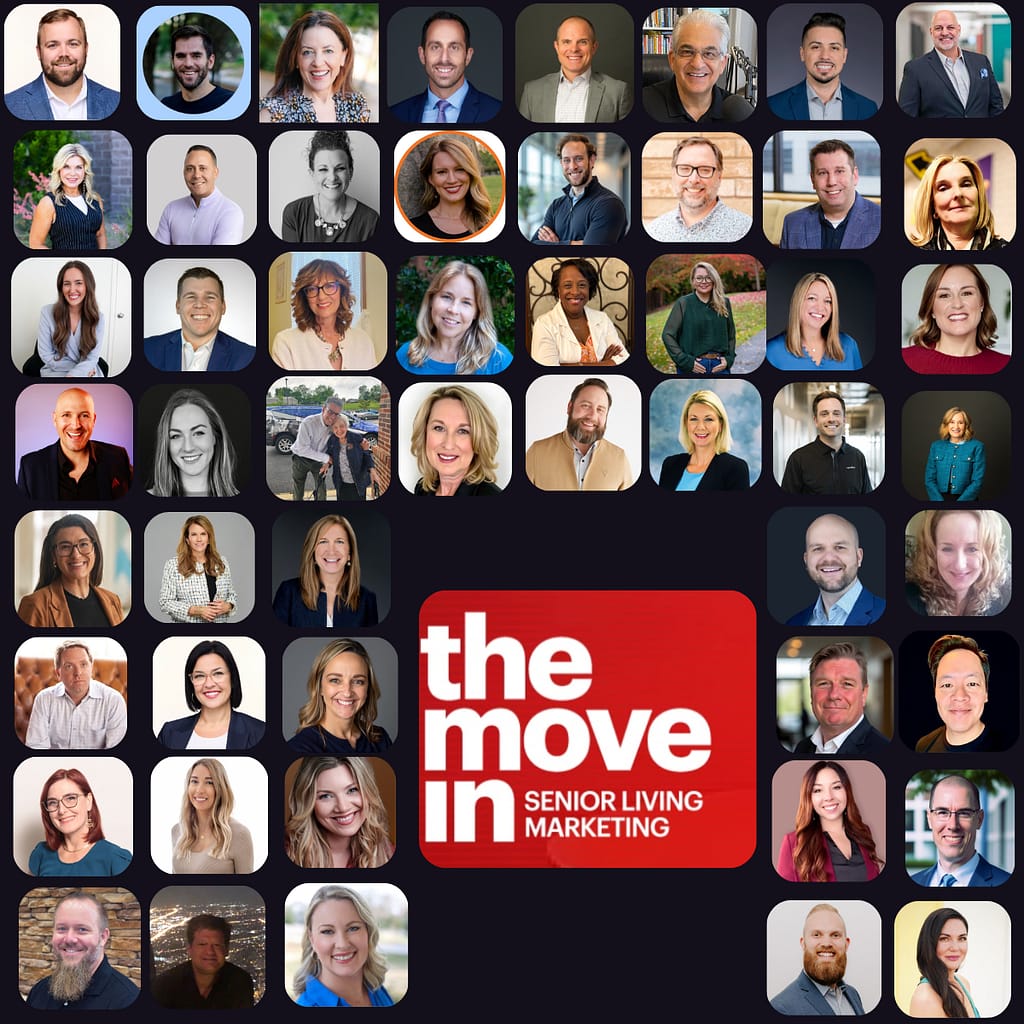

This past year of hosting conversations with senior living marketing and sales thought leaders turned into something much bigger than I expected.
What began as discussions about best practices quickly evolved into a year-long exploration of aging, caregiving, leadership, trust, culture, and the emotional realities behind one of the most misunderstood industries in America.
Each guest brought a unique perspective, but together they revealed a single, unifying truth:
Senior living isn’t just a service. It’s an emotional ecosystem, shaped by culture, discovered digitally, elevated by stories, measured by outcomes, and ultimately brought to life by humans.
Here are five lessons that stayed with me long after the microphones were turned off.
Culture isn’t what you say, it’s what you prove
Before this year, I thought of culture primarily in terms of language, encompassing mission statements, values, and employer branding. However, conversations with leaders like Katie Beach and Frank Lococo led to an evolution of that belief. Through their work at Nebraska Medicine, they demonstrated to me that culture is revealed in measurable realities, including retention, turnover, sentiment, and whether people feel they belong.
Culture is also the very first experience families have, long before they ever tour a community.
Heather Tussing reminded me that culture is immediate, and people can feel it the moment you walk through the door. Brooke Saxon-Spencer reframed marketing as a steward of internal purpose, not just an external megaphone. James Lee tied it all together by explaining how psychological safety and emotional intelligence now define success in the workforce.
The takeaway
Culture isn’t a project you launch; it’s a promise you keep. And people know instantly when that promise is broken.
The way families search for senior living has changed, permanently
If culture and care shape the inside of senior living, digital behavior defines how the outside world experiences it.
My conversation with Bailey Beeken made it clear that the shift in family search behavior isn’t theoretical; it’s already happening. AI is influencing how families discover, compare, connect with, and evaluate communities long before a phone call is ever made.
Heath Stukenholtz added important context by explaining why families gravitate toward aggregators: not convenience, but clarity. Carsten Ellsworth emphasized that high-intent SEO is more critical than ever, while Katharine Ross explored how generational differences influence trust and research habits.
The takeaway
Families haven’t just changed how they search, they’ve changed why they search. Providers who don’t evolve won’t simply lose leads; they’ll lose the trust that sustains their communities.
Storytelling moves people more than marketing ever will
No matter the topic, AI, sales, SEO, culture, nearly every conversation circled back to storytelling.
Senior living has some of the most powerful stories to share: residents, families, staff, and the place itself. This was highlighted in many conversations as Brad Bushby showed how stories restore dignity and challenge ageism. Tom Sanders reminded me that photography isn’t decoration, it’s emotional evidence. Jack York spoke about the moral responsibility of honoring resident stories, not just using them.
Any honest look at senior living marketing in 2025 must include short-form video and social media. Nathan Jones explained why short-form video is often the first emotional connection families have, long before they ever step inside a community, while Brooke Sellas urged leaders to stop treating social media like a content factory and start treating it like the digital gathering place it’s meant to be.
The takeaway
Marketing tells people what you do. Stories tell people who you are. And people choose who you are.
Technology isn’t the future, humanity is (technology just helps)
One of the biggest surprises this year was how consistently technology conversations came back to humanity.
Matt Reiners described AI agents as “digital teammates,” freeing teams to do more meaningful human work. Kaden McKenzie and Murray Mercier emphasized building ecosystems rather than chasing disconnected tools. Charlie Scholz demonstrated how AI-powered call tracking can improve attribution while strengthening speed-to-lead and responsiveness.
Across these conversations, one word kept resurfacing: experience. It’s not enough to connect the dots; we must continually improve the experience we provide. From the search all the way through to the move-in and life in the community.
The takeaway
Technology only has value when it deepens the human experience. AI isn’t here to replace people; it’s here to help us show up more fully as humans, and people crave a genuine human experience.
Selling in senior living is emotional, not transactional
Some of the most powerful conversations this year focused on sales, but not scripts, funnels, or closing techniques.
Kelly Myers showed how curiosity builds trust. Reed Davis spoke candidly about vulnerability and emotional safety as essential tools for sales. Kiera DeChamps introduced the “drive home” moment, which is the emotional crash that often occurs after a tour and determines the final decision.
Best-selling Author Bob Burg reframed sales as an act of giving, while Libby Latin highlighted the minor missteps that quietly erode trust. Christy Van Der Westhuizen brought it all together through the lens of leadership vulnerability.
The takeaway
Selling isn’t about moving people toward a decision; it’s about helping them move through emotion.
Looking ahead to 2026
Hosting this podcast has deepened my appreciation for the complexity, responsibility, and beauty of senior living. It’s an industry built on trust, emotion, and humanity, far beyond what most outsiders ever see.
Thank you to Unlock Health for your support, and to every guest who joined me this year: thank you for your honesty, insight, and willingness to share.
We are looking ahead to 2026, with exciting conversations planned and even more stories waiting to be told. I look forward to continuing to learn.