
One of the things I love most about healthcare marketing is how much possibility sits inside this work. It’s a field that never stands still. New technologies emerge, consumer expectations shift, and health systems refine the ways they deliver care. Every one of those changes creates a new opportunity for healthcare marketing teams to lead with clarity, creativity, and purpose.
So it makes perfect sense that marketing teams themselves are evolving. They’re not doing it reluctantly or reactively. They’re doing it because the business is evolving — and they want to evolve with it.
I’ve had the privilege of working alongside teams of every shape and size. What I see consistently is this: healthcare marketers care deeply about their work, their mission, and the people they serve. And they want structures, tools, and expectations that help them do that work exceptionally well.
The good news is that marketing’s role is expanding in meaningful, exciting ways. The even better news is that teams have more opportunity than ever to design the kind of operating model that reflects this moment.
Marketing is becoming a growth engine — and teams are rising to meet that opportunity
One of the most encouraging trends in healthcare marketing is how often leaders tell me they finally have a seat at the strategic table. They’re not waiting to be handed requests. They are shaping enterprise growth conversations, contributing to system-level priorities, and building smarter pathways to reach and engage patients.
That shift brings new expectations, of course. Marketing is now closely tied to access, revenue, retention, experience, and trust. But instead of viewing that as added pressure, many teams see it as an invitation — a chance to demonstrate the full breadth of what they can accomplish when aligned to business outcomes.
And when the work evolves, the structure supporting it needs to evolve too.
Teams that were built around channel execution are now rethinking how roles, workflows, and capabilities fit together. What I see emerging is thoughtful, intentional redesign — not disruption for disruption’s sake, but evolution with a clear purpose.
Healthcare marketing teams that thrive in this moment share something in common: they are built for connection and clarity
When we look at the health systems making the most progress, a pattern emerges. These teams are not necessarily larger, flashier, or more resourced. They’re simply structured in ways that make it easier for talented people to do excellent work. For successful healthcare marketing teams, a few characteristics stand out:
They’re connected.
Brand, digital, analytics, content, UX, and media don’t sit on separate islands. These functions work as one full-stack team, making smarter decisions with shared visibility.
They’re aligned.
Everyone understands what matters most: enterprise growth, access, revenue, experience, and trust. There’s clarity about what marketing owns and how it contributes.
They collaborate across capability clusters.
Rather than relying on overstretched generalists, they organize around complementary strengths — something that reduces burnout and improves quality.
They work in agile, priority-based pods when it helps them move faster.
Pods aren’t a trend. They’re a practical response to the complexity of modern marketing. They put the right people around the right problem at the right time.
They define their agency relationships with intention.
Whether they need a coach, a collaborator, or a command center — they decide deliberately and build a model that supports their goals.
These aren’t dramatic, top-down restructures. They’re measured, thoughtful shifts that make work more cohesive, more strategic, and more satisfying for the people doing it.
Understanding your team’s maturity helps you plan your next step with confidence
One framework leaders find incredibly helpful is a simple maturity model. It’s not a scorecard and certainly not a judgment. It’s a way to understand where your team is today so you can choose the right evolution path. We typically see three stages:
- Starter teams are often small, scrappy, and highly dedicated — and they accomplish a tremendous amount with limited resources. Their opportunity is prioritization: deciding what matters most and structuring accordingly.
- Mid-phase teams have an expanding set of responsibilities and emerging specialization. Their opportunity is focus: creating clarity around capabilities, expectations, and workflows so people are not spread too thin.
- Enterprise teams are built for scale, speed, and innovation. Their opportunity is refinement: optimizing pods, tightening cross-functional integration, and aligning fully to enterprise strategy.
Every stage comes with strengths. Every stage comes with opportunities. And every stage is completely valid. What matters is not where you are on the curve — it’s how clearly you can see what comes next.
Evolution is not a burden, it’s an advantage
The systems making the most progress right now aren’t the ones with the biggest budgets or the most technology. They’re the ones with leaders who embrace evolution as part of the work. They look at what marketing is being asked to do and ask, “What would make this easier, clearer, and more impactful for our team?”
That mindset opens doors. It removes friction. It creates environments where people can contribute at their highest level. And it builds trust at the executive level because the team is designed to deliver real, measurable outcomes.
Healthcare marketing is full of possibility. The evolution happening inside teams right now is a sign of strength — not strain. It tells me that leaders are paying attention, that teams are committed to the future, and that organizations are ready to unlock the full value of marketing as a growth engine.
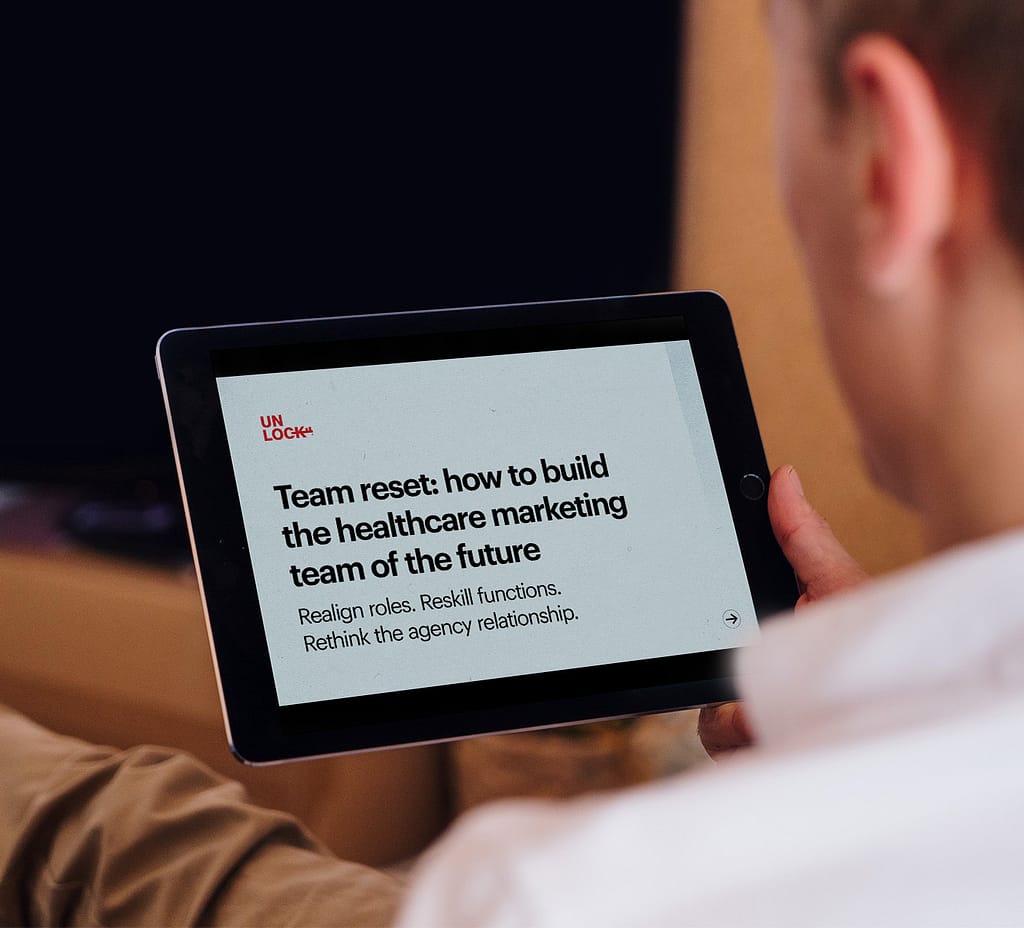
If you want to explore the five shifts we’re seeing across the most successful teams — and understand how the maturity model can guide your own evolution — we break it all down in our latest guide.