

Most healthcare organizations treat Epic as infrastructure. Highly calibrated organizations use it as leverage.
Epic sits at the center of engagement, access, analytics, and financial visibility. That position creates disproportionate impact when leaders design around outcomes and enterprise priorities.
Epic creates leverage when leaders apply intentional design, shared ownership, and operational discipline. In that context, Epic becomes more than a platform — it becomes a case study in how to maximize the performance of your MarTech system.
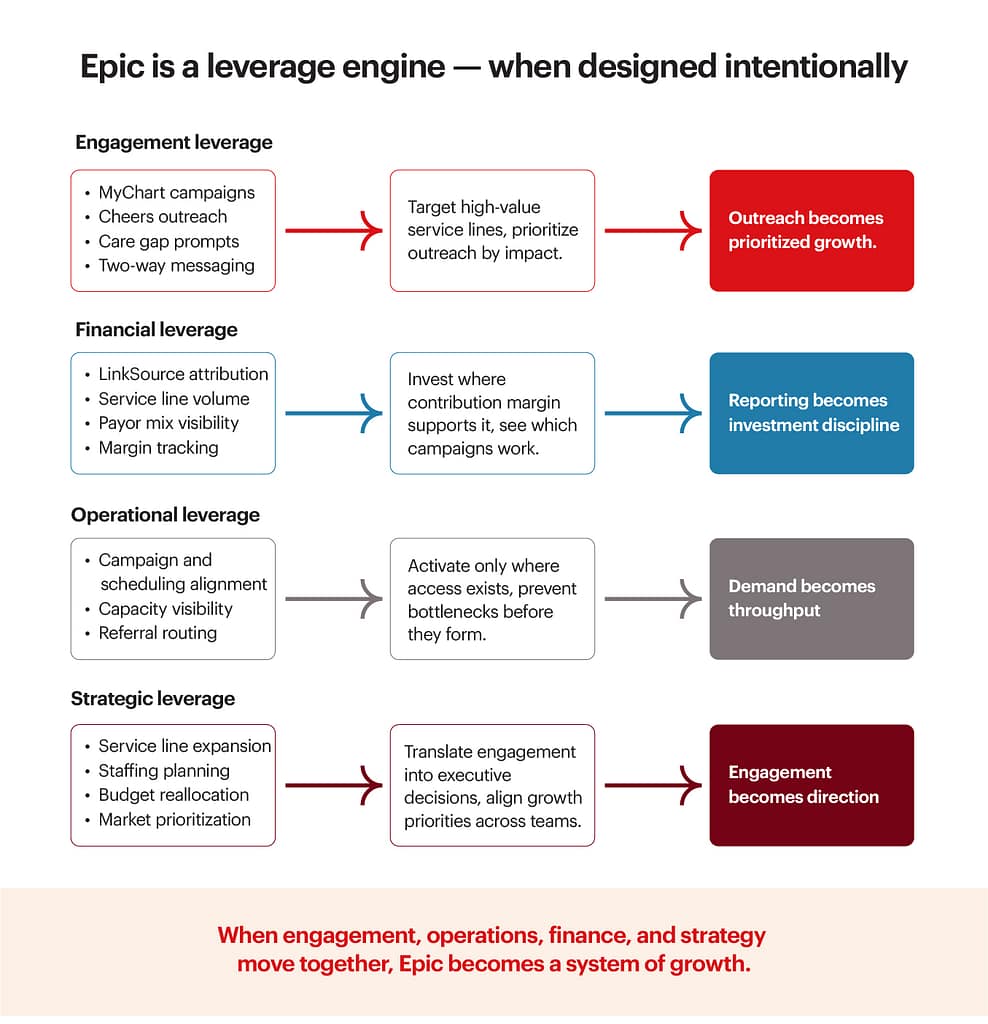
When teams treat Epic as a connected system rather than a collection of tools, four leverage zones emerge.
Engagement leverage
Epic enables marketing teams to orchestrate patient communications at scale through tools such as Cheers CRM and MyChart. Using MyChart enabled campaigns, Cheers-driven segmentation and automation, preventive care outreach workflows, and integrated two-way messaging capabilities, organizations can coordinate engagement across the patient journey within Epic’s EHR-connected ecosystem.
Scale alone does not create enterprise value. Concentration does.
Marketing leaders work with service line, finance, and strategy teams to define where growth matters most. Together, they focus outreach where clinical strength, operational readiness, and financial performance intersect.
They sequence communication based on enterprise value and confirmed capacity. Preventive outreach supports long-term population health strategy. Targeted campaigns accelerate priority service lines.
When engagement aligns with shared enterprise priorities and operational readiness, outreach becomes prioritized growth.
Financial leverage
Epic captures campaign association data, referral source tracking, encounter activity, service line performance, payor mix visibility, and contribution margin signals, depending on organizational configuration.
Caboodle consolidates this information, and Cogito presents insights through structured dashboards.
Financial leverage emerges when marketing, finance, and strategy interpret those signals together.
Leaders use contribution margin to guide budget allocation. They assess payor mix shifts alongside campaign engagement and downstream encounter activity. They align activation pacing with reimbursement realities and access capacity.
Marketing insight strengthens enterprise investment discipline when teams treat performance data as an input to capital allocation decisions.
When reporting informs resource allocation across departments, marketing performance becomes financially accountable.
Operational leverage
Epic connects campaigns and outreach workflows to scheduling templates, referral routing logic, and access workflows. Marketing activity can influence operational performance in real time when properly coordinated.
Leverage emerges when marketing, access, operational, and IT leaders coordinate activation timing. Teams confirm scheduling capacity before launch. Referral logic aligns with campaign targets. Workflow integrity remains intact.
Cross-functional coordination transforms marketing demand into sustained throughput.
When teams operate with shared visibility and disciplined execution, growth initiatives reinforce clinical delivery rather than strain it.
Operational leverage strengthens patient flow and enterprise efficiency simultaneously.
Strategic leverage
Epic engagement and analytics surface internal performance signals beyond campaign metrics. They reveal service line utilization patterns, growth opportunity indicators, access constraints, and payor mix dynamics.
Marketing leaders bring these signals to strategy, finance, and managed care teams. Together, they evaluate performance relative to regional demand, competitor positioning, and reimbursement trends.
They layer Epic performance data with external market intelligence and national/regional payor insights. They identify where payor concentration creates risk. They assess where margin headroom supports expansion. They align growth priorities with contract positioning and access capacity.
When internal performance signals meet external market intelligence, insight becomes shared enterprise direction.
Strategic leverage elevates marketing from execution support to enterprise influence.
Epic already occupies a central position in healthcare organizations.
When leaders treat that position as leverage, they amplify performance across engagement, finance, operations, and strategy.
Epic often does not require additional platforms to create impact when its native capabilities are intentionally aligned and governed.
In Stop the sprawl: maximizing your MarTech, we describe how organizations move from accumulation to leverage. Epic provides a clear case study in what that leverage looks like inside a unified, EHR-centered, platform.
When cross-functional leaders align around outcomes and act on shared signals, Epic becomes more than a platform.
It becomes a force multiplier for enterprise performance.
Lisa Bevere holds certifications from Epic in MyChart Analyst and Hello World.