
Google Marketing Live (GML) 2026 happened last week, and there was a lot to digest! It was filled with many developments healthcare marketers and advertisers may value, but it threw up just as many questions. So where are we?
As a note, many initiatives are either going fully live in June 2026 or will be in testing until toward the end of that month. Others are rolling out of beta later in the year. Let’s take a look at them and I’ll give you our hot takes on each.
Ads in AI Mode
What’s happening
The biggest story was that Ads in AI Mode are here, and are being tested for a late-June/early-July full launch. This will include healthcare ads, so this is a brand new space to place ads for our clients. These placements are restricted to delivery via Broad match keywords, AI Max, or Performance Max (AKA Pmax) campaign types.
Unlock’s take: If you have the budget/capacity, a real, but risky, opportunity
We would only recommend entering the AI Mode space after exhausting the more directly relevant and controllable keyword universe first. Only then, if scaling was required, would we recommend adding AI Mode traffic — especially via an effectively keywordless targeting method like AI Max or Pmax.
Bear in mind that, once in AI Max or Pmax, AI Mode search queries reported will not be the terms actually used by a user. Instead, reports will show an AI-built close intent-based approximation of the activity that triggered the ad. Why? Because AI can use multi-modal search methods that include long-form chat and even uploading an image, audio, or video.
Google will figure out what the image/audio/video is and map some sort of representative “search term” for it in the search query report. Of course, this means trying to use negative keywords against these Search Query “ghosts” will likely not be especially effective. This leaves only bidding to a CPA (or ROAS) as the best method of limiting how far out into the query ocean your campaign swims.
Yes, there are other guardrails available, like the landing page content and the ad creative (more on that later). But this doesn’t constrain query matching, as such, so much as it gives it a starting point.
On the surface it’s exciting that we can get healthcare ads into AI mode. However, it is a path that should be approached for the right reasons, in the right way, and with the right expectations.
A serious aspect to this that clients may face is that it is much harder to stick to dedicated budgets to certain services (within service lines) in this context. For instance, if you have a kidney transplant marketing budget within your Urology service line as distinct from general Urology services, the AI Max campaign type may trample all over this setup. How they might stick to their lanes if there are separate campaigns for these, needs to be tested, but it would initially seem to be a major challenge.
Broad match usage is a good way to see the impact of AI Overview and AI Mode ads, but we cannot report on those placements at all, due to Google’s current settings. We hope they will soon allow for this kind of insight.
Testing is encouraged, however. If any Unlock clients want to devote some budget to assessing the potential, we will be delighted to collaborate to engineer a meaningful test.
AI Max compliance messaging controls
What’s happening
Google also realizes that healthcare needs to stay compliant even when optimizing automation. Fortunately, they’ve taken these steps:
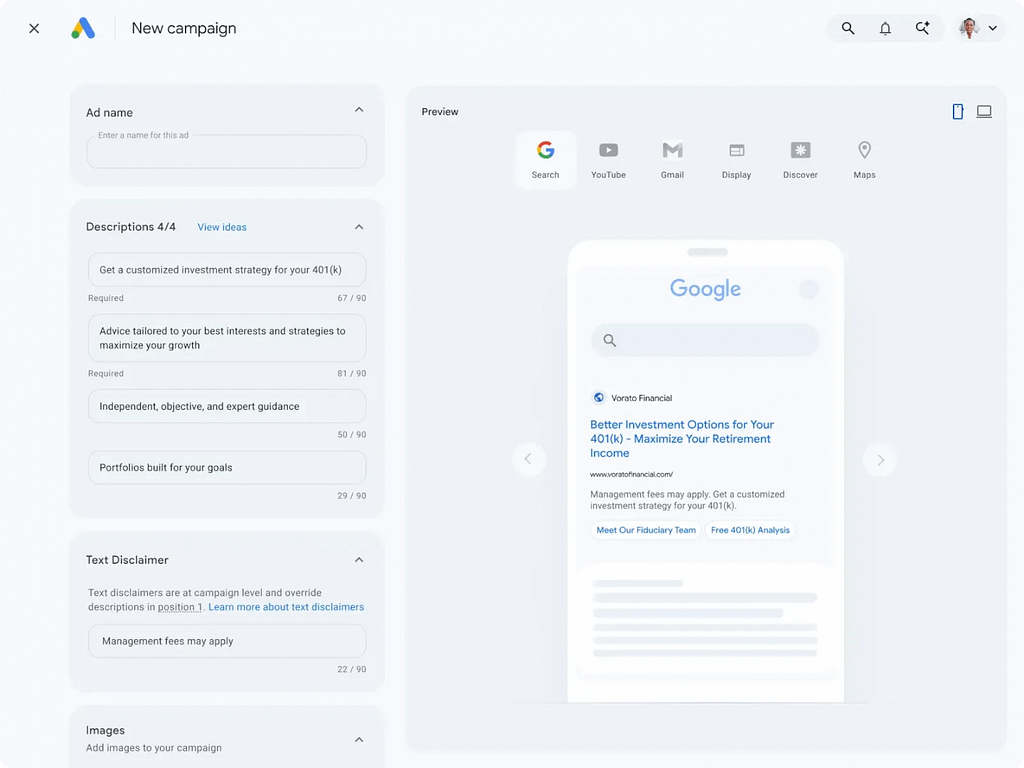
- Industry-specific AI guardrails: Google now allows healthcare marketers and advertisers to provide explicit messaging and audience guidelines in natural language via a feature called “AI Brief.” This ensures AI-generated content adheres to strict legal reviews and messaging standards required in the sector.
- Guaranteed text disclaimers: A new feature guarantees that required regulatory or legal text will always appear in ads (even when using “final URL expansion” which dynamically sends users to the most relevant landing page, something we generally don’t recommend using in healthcare).
Unlock’s take: cautiously optimistic
This will certainly make it more of a practical option to take AI Mode ads via AI Max to clients. If it works as hoped, this will reduce friction and help us maximize the impact of healthcare ads in the space. We are already building SEM campaigns to steer AI Max implementation as efficiently as possible, but the added messaging controls seem like they will be a big help. More to come once we’re able to test real ads.
Conversational lead generation
What’s happening
Though it’s so often seen as heavily e-commerce oriented, Google has stepped up its lead generation game, and is make several new changes in that direction:
- Centralized lead management hub: “Leads in Google Ads” serves as a lightweight, built-in CRM to manage Google-hosted form leads and ensure no prospect falls through the cracks.
- Business agent for leads: This tool enables an AI-enabled conversational exchange directly within Search Ads. Prospective patients can ask specific questions about services at any hour, with answers grounded in the provider’s actual website content, capturing lead data even when staff are offline.
- Lead intent scoring: Integrated directly into Google Ads lead form capturing, this feature surfaces leads most likely to convert while filtering out low-intent or spam submissions – so advertisers never waste time on those leads likely to be unworthy of attention.
Unlock’s take: too soon to tell
As ever with anything relating to data collection, the mantra has to be “compliance, compliance, compliance” first, second, and last. We must therefore investigate these options further for practicality and compliance. So, we won’t comment too much on these just yet.
Advanced bidding and optimization
What’s happening
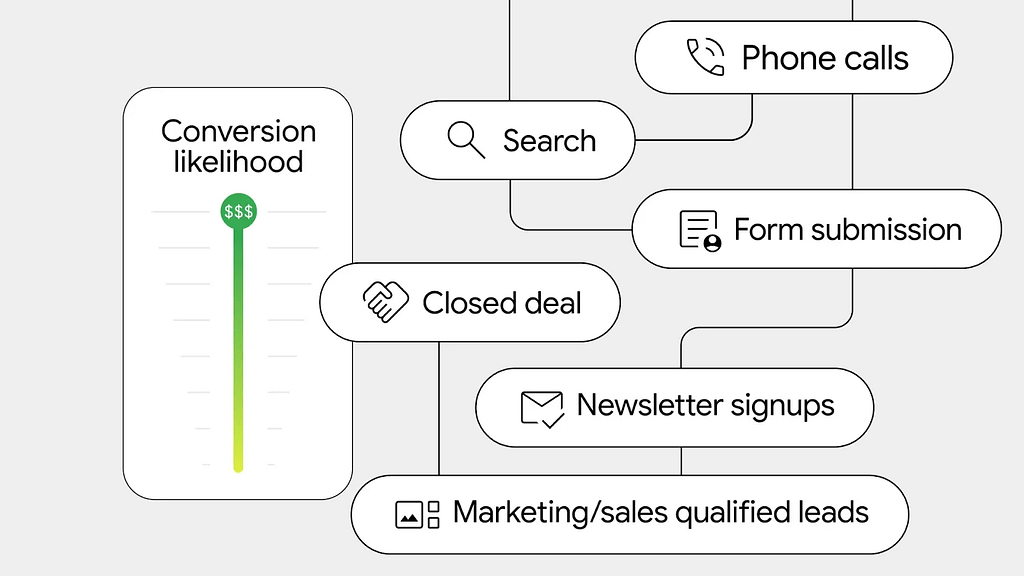
- Journey-aware bidding: Advertisers can now share the full patient journey — from initial lead to final appointment — enabling bidding algorithms to learn from every goal (even secondary conversion actions) along the path rather than just the final conversion.
- Smart bidding exploration: Coming out of Beta, available in AI Max and Performance Max campaigns, this allows the system more flexibility to convert on search terms that were previously missed due to strict ROAS/CPA targets.
- Campaign type attribution: Attribute the full value of your conversions from demand gen campaigns to optimize in-platform and calibrate cross-platform.
- New prospects traffic mode uses a bundle of automated exclusions to ensure your ads only reach “cold” audiences. It automatically filters out users who have:
- Purchased from you (via customer match and tags)
- Searched for your brand terms
- Visited your website or used your app
- Engaged with your content or ads across Google and YouTube
Unlock’s take: some genuinely exciting options here
Journey aware bidding will be the most impactful — and it will roll out naturally as long as you have a suite of secondary conversion actions collecting data. We recommend adding any you may not have already added as soon as you can.
Like AI mode, if you need to scale, smart bidding can work in conjunction with AI Max bringing you into AI Mode. Since many healthcare marketers are struggling to find adequate budget just for the (stronger) primary keyword universe, the use case opportunity is relatively limited. If you need to scale, though, for sure try it.
Campaign type attribution gives us transparency and actionable data, which can never be bad. And the New Prospects traffic option can potentially ensure your prospecting budget really does drive patient growth beyond those familiar with your brand. Both need to be seen in real life to have a final take on it, though.
Creative and brand integration/impact
They did announce a lot related to demand gen campaigns — partly because they are now the only tCPA version of YouTube campaigns, and partly because they have such a heavy conversion focus to them. They feature options like Sponsored Map Pins that Performance Max doesn’t offer, and there is lots of control in comparison.
There were also some measurement/metric updates but here are some highlights (not exhaustive):
- Creator partnerships boost: Healthcare brands can now transform organic creator and influencer content into Demand Gen ads directly through the asset picker, simplifying the process of finding and leveraging trusted partners.
- Sponsored map pins: Through Demand Gen, reach high-intent users while they’re actively navigating or exploring locally.
- Attributed Branded Searches (ABS): This metric provides a direct link between users seeing an ad and subsequently searching for the provider’s brand, offering a clear signal of created intent.
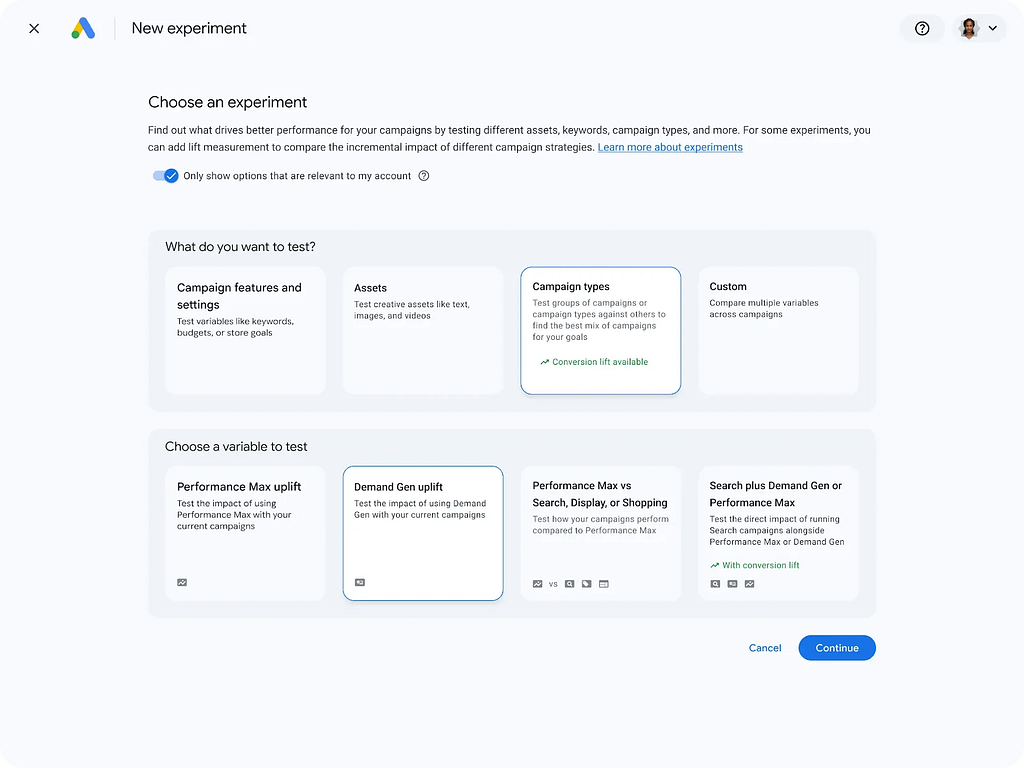
- Demand Gen uplift experiments: Measures statistically significant uplift of adding Demand Gen to your existing comparable campaign mix
Unlock’s take: ask us again in July
As most of these are only going to fully see the light of day in June, we will hold any firm judgment. However, the creator partnerships options are fascinating, and a potentially powerful way to drive your brand into hard-to-reach (and influence) audiences. The map pins will undoubtedly help to win market share, and the lift experiments will validate the impact we may get from Demand Gen. The Attributed Branded Searches metric can give us otherwise impossible insights on our strategies, and bypasses explicit audience construction, which is notoriously challenging in healthcare.
Conclusion
There’s much to chew on after GML, and many tests await the Unlock Performance Marketing team this summer! But none of this changes the basic fundamentals of our approach, and the priorities we work on with our clients:
- High-intent, efficient patient growth-oriented search campaigns
- A foundation of compliant, reliable, well-rounded tracking and measurement
- Custom, but consistently applied management methodology driven by the specific goals of the client
- Leading-edge proprietary technology, forward-leaning strategic thinking, and expertise formed from many years of healthcare marketing experience.
We’ll rigorously examine all of these developments for compliance and test them for efficacy in collaboration with our clients before we come back with more thoughts in the coming months.