

Most health systems using Epic already have marketing, engagement, and analytics capabilities embedded within the platform.
MyChart builder, Cheers CRM, Hello World, LinkSource, Caboodle, and Cogito form a strong operational foundation when properly configured. These tools support engagement, access, and analytics across the enterprise. The opportunity lies in aligning them intentionally to support measurable outcomes.
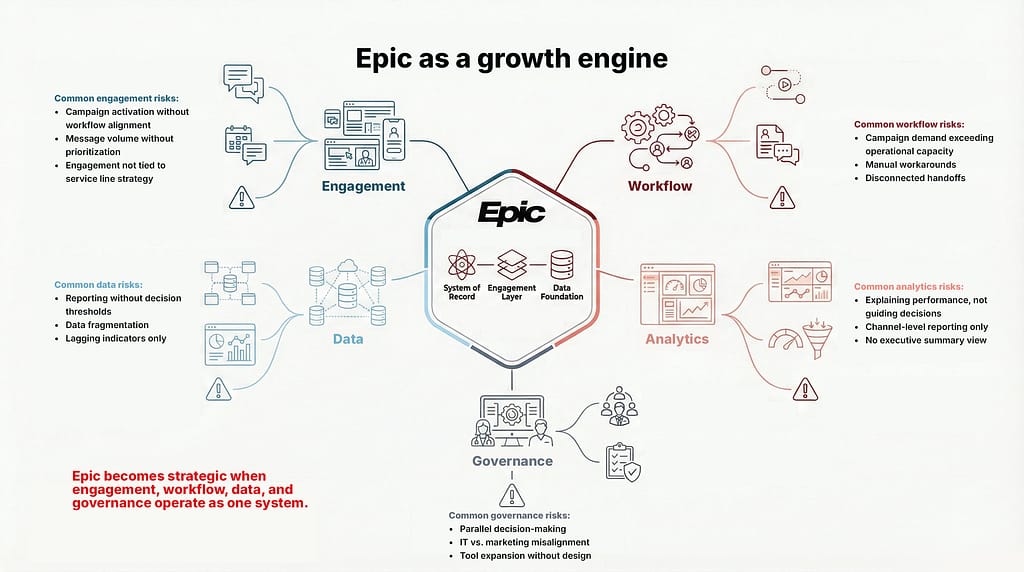
When teams connect engagement configuration, operational workflows, data structures, analytics review processes, and governance, Epic can function as a unified growth system. That shift requires coordination and clarity, not necessarily additional technology.
How to make Epic engagement strategic
Epic makes outreach activation relatively straightforward across defined patient segments when segmentation and communication governance are established. Teams configure Cheers Campaigns, deploy outreach through MyChart and other enabled channels, and activate preventive care reminders based on health maintenance logic. Two-way messaging can support ongoing patient connection when routing and staffing workflows are defined.
Because activation can be operationally efficient, organizations often expand outreach quickly. Without defined service line priorities and capacity validation, engagement spreads broadly instead of strategically. Volume increases, yet measurable impact becomes harder to isolate.
Leaders create leverage by anchoring outreach to defined enterprise objectives. They align campaigns to prioritized service lines, contribution margin realities, and confirmed access capacity. When activation follows strategy, engagement strengthens enterprise performance instead of simply increasing activity.
Epic enables scale within EHR-governed workflows. Leadership alignment determines direction.
How Epic workflow alignment improves access and throughput
Campaigns and outreach workflows interact with scheduling templates, referral routing logic, access work queues, and In Basket management. Marketing and operations share responsibility for the outcomes.
When teams activate campaigns without confirming access readiness, demand stresses the system. Bottlenecks form. Manual workarounds emerge. Friction grows quietly.
Organizations that avoid this pattern coordinate before launch. Leaders review scheduling capacity, confirm referral routing configuration, and clarify operational ownership. Outreach then reinforces available access rather than overwhelming it.
With alignment, demand moves through existing workflows with greater predictability.
Epic supports cross-functional coordination through shared system visibility. Teams must operationalize that coordination.
How Epic analytics drive smarter marketing decisions
Epic captures campaign association data, encounter history, service line metadata, payor mix visibility, and utilization patterns, depending on configuration. Caboodle aggregates this information, and Cogito presents insights through dashboards.
Dashboards alone do not create leverage. When teams review performance without defined decision criteria, reporting becomes routine instead of strategic.
Growth-focused organizations establish clear thresholds that guide action. Leaders use contribution margin to inform budget decisions. They pace activation based on documented capacity levels. They refine targeting using payor mix distribution and historical utilization data.
When teams apply defined decision frameworks, analytics inform capital allocation and operational prioritization.
Epic provides structured visibility into internal performance data. Leadership determines how those insights shape decisions.
Why Epic governance determines long-term performance
Long-term leverage depends on defined ownership and governance structure. Leaders assign accountability for marketing configuration, data standards, workflow alignment, analytics review cadence and release management.
When coordination lacks structure, fragmentation appears gradually. Marketing and IT workflows drift. New functionality is enabled without shared design standards. Measurement definitions diverge.
Strong governance maintains alignment between engagement strategy, operational workflow, and reporting standards. Leaders define decision rights and reinforce cross-functional coordination. Teams preserve structural discipline even as priorities evolve.
Epic scales most effectively when governance remains intentional and cross-functional.
Turning Epic into a healthcare growth strategy
Epic already contains much of the infrastructure required to support coordinated growth when properly configured and aligned.
The question is not whether Epic can do more. The question is whether your organization has intentionally designed how it uses Epic to support defined enterprise outcomes.
Growth rarely stalls because of missing features. It stalls because systems evolve incrementally — without a shared view of enterprise performance design.
Maximizing your MarTech requires stepping back, defining outcomes, clarifying ownership, designing workflows and measurement frameworks around them — whether your ecosystem spans multiple platforms or anchors on one.
In Stop the sprawl: maximizing your MarTech, we outline the shifts that move organizations from accumulation to intentional architecture, from reporting to decision governance, and from platform gravity to right-fit ecosystems. Those shifts apply equally when Epic functions as the operational center of engagement and analytics.
When teams align engagement, workflow, data, analytics, and governance, Epic moves beyond infrastructure. It becomes a growth engine that shapes strategy and drives enterprise performance.
That work starts with clarity.
Lisa Bevere holds certifications from Epic in MyChart Analyst and Hello World.